The best magnetic stimulation center in Egypt: Dr. Shereen Fawaz's leadership in neurorehabilitation
When a patient faces the challenges of a stroke or nerve injuries and the resulting weakness in movement, the question arises about modern techniques that help the nervous system regain its functions. Transcranial magnetic stimulation (TMS) is one of the most prominent of these solutions, but success depends less on the device than on specialist medical assessment.
What is transcranial magnetic stimulation (TMS)?
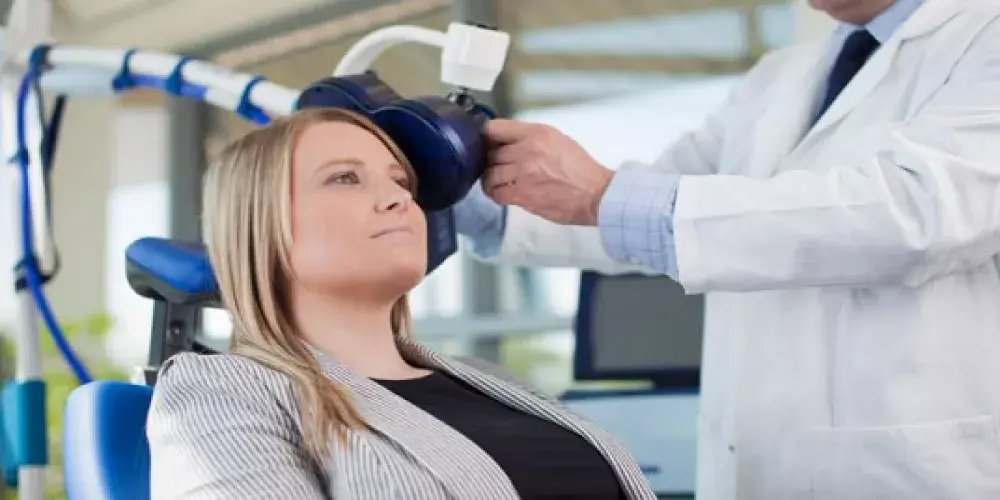
Transcranial Magnetic Stimulation (TMS) is a non-surgical procedure that uses focused magnetic fields to stimulate nerve cells in specific areas of the brain.
No surgery: the procedure is performed without any skin incision or anesthesia
How it works: it stimulates the neural circuits responsible for movement, control and balance, which can be disrupted by neurological injuries.
A supportive tool: the technique is not a magic solution on its own, but a powerful tool when integrated into a comprehensive neurorehabilitation plan.
Why choose Dr. Shereen Fawaz's clinic for neurorehabilitation?
The fundamental difference between Dr. Shereen Fawaz's clinic and any other place that owns the device lies in the comprehensive medical vision.
Leadership and experience: Dr. Shereen Fawaz is a consultant in physical medicine, rheumatology and rehabilitation at Ain Shams University and a Fellow of the Royal College of Physicians, and a pioneer in developing the non-invasive neuromodulation approach in Egypt.
Precise functional assessment: we do not start sessions right away; we begin with a plan built on understanding the medical history and measuring strength, balance and muscle control.
Combining techniques: TMS is combined with physical therapy and motor and functional training to ensure improved independence in daily life.
Conditions that may benefit from TMS sessions
Magnetic stimulation is used as a supportive part of neurorehabilitation programs in the following cases, depending on the doctor's assessment:
1. Rehabilitation after stroke
After a stroke, a patient may suffer weakness in the limbs or difficulty with balance. TMS helps support motor recovery when combined with specialized rehabilitation programs.
2. Muscle spasticity resulting from nerve injuries
Spasticity is often the result of a disruption in signals between the brain and muscles. A careful assessment helps determine how much the patient needs neural stimulation alongside physical and medication therapy.
3. Difficulty walking and poor balance
When the problem lies in neural communication, we design a comprehensive program that includes gait training and improved neural control to increase the patient's stability.
Safety and precautions when using magnetic stimulation
Although TMS is a safe, non-invasive procedure, it is not suitable for everyone. Contraindications: caution should be taken, or sessions avoided, where there are implanted devices or metal in the body, or a history of seizures. Side effects: it may occasionally cause a mild headache or temporary scalp discomfort. Medical decision: starting sessions depends on the doctor’s assessment, not on other patients’ experiences.
Common mistakes to avoid
Believing the device alone is enough: without a rehabilitation and functional training plan, the desired results may not be achieved. Expecting immediate results: improvement appears gradually in details such as steadier steps or better hand control. Stopping physical therapy: TMS is a supportive tool and does not replace exercise and motor training.
Book a specialist assessment now
If you suffer from weak movement, difficulty walking or muscle spasticity after a stroke or nerve injury, you can book an appointment with Dr. Shereen Fawaz to set a rehabilitation plan based on your actual needs.
Frequently asked questions about neurorehabilitation and magnetic stimulation (TMS)
Do TMS sessions require anesthesia?
No, sessions are performed while the patient is fully awake, and they are non-surgical.
What is transcranial magnetic stimulation?
Transcranial magnetic stimulation (TMS) is a non-invasive technique that uses focused magnetic pulses to activate specific areas of the brain.
It is delivered through a device placed near the head, without surgery or anesthesia, with the aim of influencing the activity of certain neural circuits responsible for movement, control or some neurological functions.
In neurorehabilitation, magnetic stimulation may be used as a supportive part alongside physical therapy and motor rehabilitation, especially in some post-stroke cases or nervous system injuries.
Does magnetic stimulation work as a treatment on its own?
No.
And this is a very important point.
Magnetic stimulation does not replace physical therapy or neurorehabilitation.
More precisely, it may help some cases when it is part of a complete treatment plan that includes:
A medical assessment of the case.
Physical therapy and motor rehabilitation.
Walking and balance training.
Improving hand use and daily functions.
Monitoring muscle spasticity and motor control.
Using assistive techniques when needed.
Put simply:
The device alone is not enough… the integrated medical plan is what matters most.
How do you choose the best magnetic stimulation center in Egypt?
Why Dr. Shereen Fawaz’s clinic?
Why Dr. Shereen Fawaz's clinic?
Dr. Shereen Fawaz specializes in physical medicine, rheumatology and rehabilitation, and has experience handling complex neurological and motor rehabilitation cases, such as post-stroke cases, weak movement, gait disorders, muscle spasticity and nervous system injuries.
What distinguishes the clinic is that magnetic stimulation is not treated as just a device, but as part of a broader treatment vision that includes:
Medical assessment + neurorehabilitation program + assistive techniques + functional follow-up according to each patient’s condition.
For this reason, Dr. Shereen Fawaz can be described as one of the pioneers in neurorehabilitation and non-invasive neurostimulation/neuromodulation in Egypt, with the commitment that every case needs its own assessment and a suitable plan.