
Shoulder Pain After a Stroke: Why Does It Happen and How Does Early Rehabilitation Help?
Why does a stroke patient complain of shoulder pain?
After a stroke, the family may notice that the patient has begun to improve in sitting or walking, but the weak arm is still painful, especially when changing clothes, moving the hand, or during sleep.
The patient may say: “My shoulder hurts when someone moves my hand” or “I can’t lift my arm like before.”
Here, attention is needed: shoulder pain after a stroke is not a minor symptom to ignore, and it is not right to deal with it by force or by pulling the arm in order to “free the movement”.
Shoulder pain after a stroke is one of the common problems in neurorehabilitation. It may affect the use of the arm and hand, reduce the patient’s participation in exercises, and increase stiffness if it is not dealt with early and in the right way.
What happens to the shoulder after a stroke?
The shoulder is a joint with a wide range of movement, but it needs a precise balance between the muscles that stabilize it and move it. After a stroke, weakness may occur in the muscles responsible for stabilizing the shoulder joint, especially on the affected side.
With this weakness, the shoulder becomes less stable, and can easily be affected by wrong movement, pulling, or leaving the arm hanging for long periods.
The problem is that the arm after a stroke is not just “weak muscles”; the nerve signals coming from the brain to the muscles are also affected. So the patient needs neurological and motor rehabilitation that helps the brain and muscles regain control gradually as far as possible.
Causes of shoulder pain after a stroke
Shoulder pain after a stroke can happen for more than one reason, and sometimes more than one factor combines in the same patient.
1. Weakness of the muscles around the shoulder joint
After a stroke, the muscles that hold the shoulder joint in its natural place may weaken. With the weakness of these muscles, the joint becomes more prone to pain, especially when the arm is moved or left unsupported.
2. Moving the arm in the wrong way
A common mistake is for a family member or companion to pull the patient by the weak hand or arm when helping them stand or move. This pulling may increase the pain, and may press on the shoulder joint in an unsuitable way.
3. Joint stiffness and lack of movement
When the arm is used less for a long time, gradual stiffness may occur in the shoulder. With stiffness, movement becomes more painful, so the patient avoids moving the arm, and the stiffness increases further: pain → less movement → stiffness → more pain.
4. Increased muscle tension after a stroke
Some patients suffer from increased muscle tension or spasm after a stroke, which may affect the position of the arm and shoulder and make movement more difficult and painful.
5. The position of the arm when sitting or sleeping
Leaving the weak arm hanging while sitting, or placing it in an uncomfortable way during sleep, may increase pain, swelling or stiffness. So teaching the family how to support the arm at home is a very important part of the rehabilitation plan.
Does shoulder pain after a stroke affect the return of hand movement?
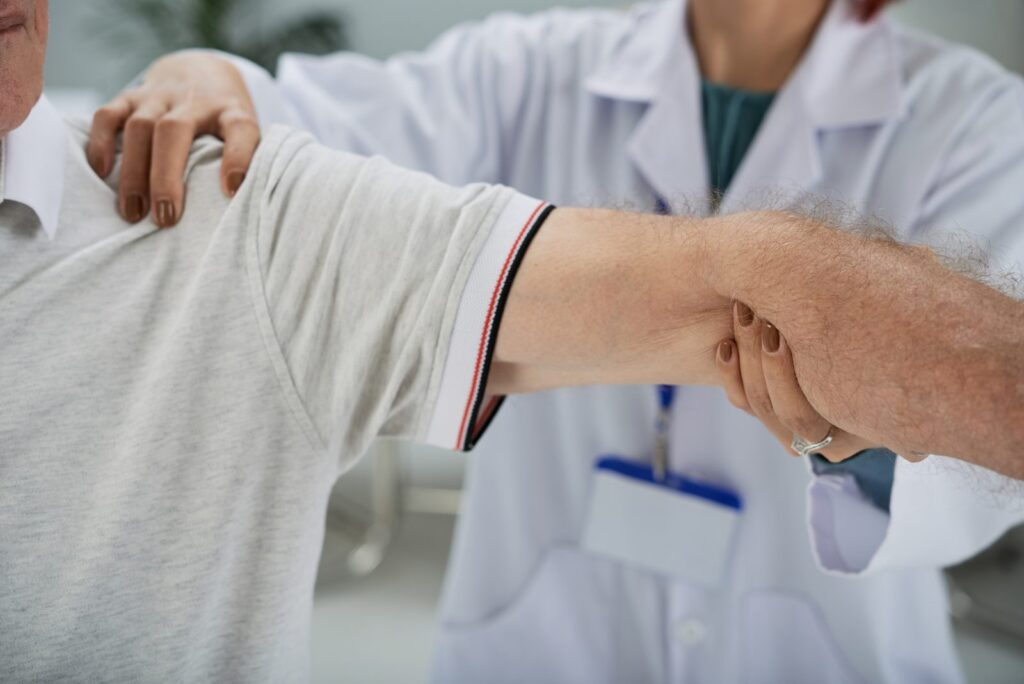
Yes, it may. If the shoulder is painful, the patient will often try to avoid using the arm. With less use, there are fewer opportunities to train the hand and arm in daily life.
This is very important, because hand rehabilitation after a stroke needs repetition and continuous functional training, not just passive moving of the arm. The less the pain and the safer the movement, the easier it becomes to train the patient to use the arm and hand in activities such as grasping, dressing, eating, or safe leaning.
When does shoulder pain after a stroke need a specialist assessment?
It is preferable to assess a stroke patient early if any of the following signs appear:
- Pain in the shoulder or weak arm.
- Difficulty lifting the arm.
- Pain when changing clothes.
- Pain when sleeping on the affected side.
- Swelling in the hand or arm.
- Stiffness in the shoulder, elbow or fingers.
- Marked muscle tension in the arm.
- The patient refusing to move the hand because of pain.
- Pain that increases when a companion tries to move the arm.
Early assessment helps determine the cause of the pain, reduce complications, and set a safe plan for moving the shoulder and arm.
How does rehabilitation help treat shoulder pain after a stroke?
Rehabilitation after a stroke does not focus only on walking or leg movement. The shoulder, arm and hand need an assessment and a careful plan from the start. A rehabilitation plan may include:
- Supporting the shoulder and arm in correct positions.
- Moving the joint in a safe and gentle way.
- Gradually reducing stiffness.
- Training the weak muscles around the shoulder.
- Improving the range of movement without force.
- Training the arm and hand for daily use.
- Reducing muscle tension when present.
- Teaching the family the correct way to help the patient at home.
Most importantly, rehabilitation does not depend on pulling or force. It depends on safe movement, gradual progress, and a correct understanding of the nature of nervous system injury after a stroke.
Common mistakes that may increase shoulder pain after a stroke
There are some actions done with good intentions that may increase the pain:
Pulling the patient by the weak arm
A stroke patient should not be helped to stand or move from one place to another by pulling the affected arm.
Moving the shoulder forcefully
Moving the shoulder with force in order to “free the stiffness” may increase the pain and make the patient refuse movement.
Leaving the arm hanging
The weak arm needs suitable support while sitting or sleeping.
Ignoring the pain
Persistent pain may prevent the patient from taking part in rehabilitation, so its cause must be understood early.
Relying on painkillers only
A painkiller may help temporarily, but it does not treat the cause if there is muscle weakness, stiffness, tension or a wrong position.
Can magnetic stimulation be used in rehabilitating shoulder pain after a stroke?
Magnetic stimulation does not directly treat shoulder pain in all cases, and it is not used as a substitute for motor rehabilitation.
But in some stroke patients, magnetic stimulation of the brain may be a supportive part of the neurorehabilitation program, especially if the aim is to support the response of the brain and nervous system to motor training, and to improve control of the weak limb.
It may be combined with a rehabilitation program that includes training the arm and hand, improving motor control, reducing reliance on the healthy limb, and activating use of the affected limb in daily life. But the decision depends on the doctor’s assessment, the location of the stroke, the degree of weakness, and the stage of recovery.
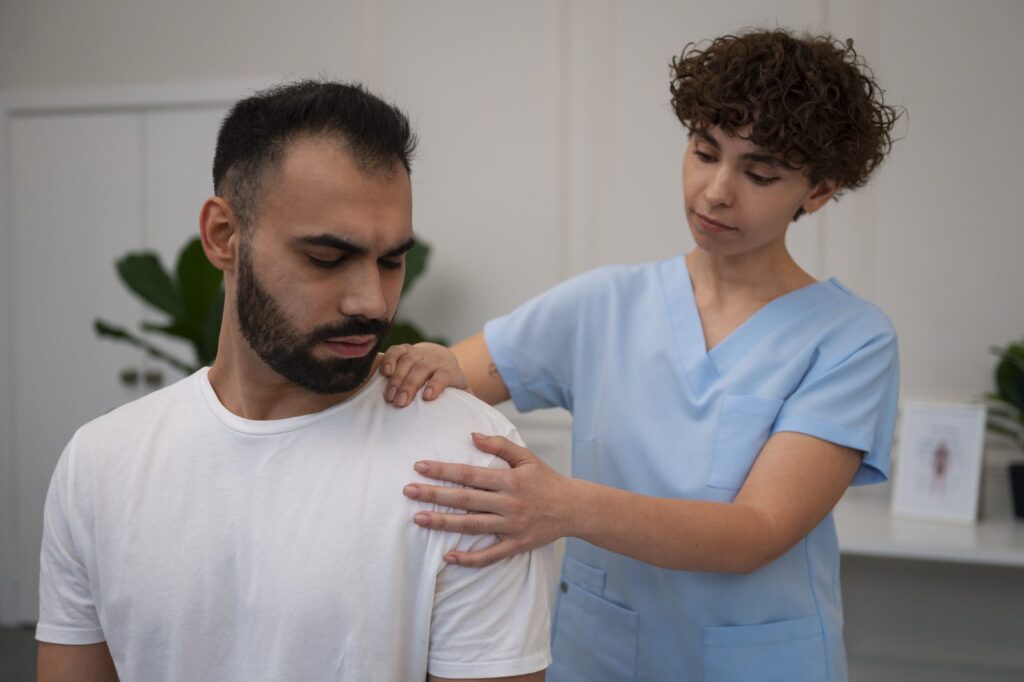
Does neurofeedback have a role after a stroke?
In some cases, the stroke patient’s problem is not only motor. The patient may suffer from poor concentration, slow response, tension, sleep disturbance, or difficulty paying attention during training. These factors may affect the quality of rehabilitation.
In some cases, neurofeedback may be a supportive tool within the plan, aiming to train the nervous system to regulate activity better. But like magnetic stimulation, it is not used randomly, but after a careful assessment of the case and its needs.
How can the family help a stroke patient at home?
The family’s role is very important, but it must be based on correct guidance. Important tips include:
- Do not pull the patient by the affected arm.
- Support the arm while sitting.
- Place the arm comfortably during sleep.
- Do not force the patient into painful movement.
- Encourage safe movement according to the doctor’s instructions.
- Monitor any swelling or increase in pain.
- Stick to the rehabilitation plan and do not rely on random exercises.
The home is an important part of the rehabilitation journey, and sometimes the way of handling things day to day makes a big difference in reducing pain and preventing stiffness.
Frequently asked questions about shoulder pain after a stroke
Is shoulder pain normal after a stroke? Shoulder pain commonly occurs after a stroke, but it is not something to ignore. It needs assessment to find the cause and set a suitable plan.
Can the weak arm be moved after a stroke? Yes, but the movement must be done in a safe way suited to the patient’s condition, without pulling or force.
Does shoulder pain prevent hand movement from returning? Shoulder pain may reduce use of the arm and hand, which may affect training and rehabilitation. So it must be dealt with early.
Does magnetic stimulation help with shoulder pain after a stroke? It may be useful in some cases of neurorehabilitation after a stroke, but it is not a direct treatment for every shoulder pain, and it does not suit every patient.
When should I visit a rehabilitation doctor? If shoulder pain, stiffness, swelling, arm weakness, or difficulty using the hand appears after a stroke, it is best to have the case assessed early.
The role of Dr. Shereen Fawaz's clinic
At Dr. Shereen Fawaz’s clinic, shoulder pain after a stroke is assessed through a careful examination of movement, nerves, muscles, joints, arm position, and how far the hand is used in daily life.
A suitable rehabilitation plan is set for each patient, aiming to reduce pain, protect the shoulder joint, improve movement, train the arm and hand, and teach the family the correct way to handle the affected limb at home.
The plan may include supportive means such as magnetic stimulation or neurofeedback when suitable for the case, within an integrated neurological and motor rehabilitation program.
Dr. Shereen Fawaz has expertise in physical medicine, rheumatology and rehabilitation, and in the rehabilitation of neurological and movement disorders, with particular experience in magnetic stimulation. She is one of the pioneers of magnetic stimulation in Egypt and the founder of the first center in Egypt specializing in magnetic stimulation and rehabilitation.
Conclusion
Shoulder pain after a stroke is not just a passing pain, and it may affect arm and hand movement and the whole recovery journey if it is not dealt with early.
The cause may be weakness of the muscles around the shoulder, joint stiffness, moving the arm in the wrong way, increased muscle tension, or unsuitable positions while sitting and sleeping.
The right treatment starts with a specialist assessment, then a safe and suitable rehabilitation plan, with teaching the family how to handle the affected arm at home.
If a stroke patient suffers from shoulder pain, arm weakness, stiffness, muscle tension, or difficulty using the hand, early assessment may help reduce pain and improve the chances of rehabilitation.
To book or enquire:
📲 01030020829
📲 0224153602
📍 6 Kolleyet El Banat Project, behind Air Defense House, Nasr City, Cairo, Egypt
- All Posts
- Uncategorized
The Role of Magnetic Stimulation in Stroke Rehabilitation: When It...
Hand Numbness While Sleeping: Is It a Pinched Nerve or...

Why Does a Stroke Patient’s Improvement Stop After a While,...
Book a specialist assessment
If you or a family member has weak movement, difficulty walking, muscle stiffness, or slow improvement after a stroke or nerve injury, you can book a specialist assessment with Dr. Shereen Fawaz to find out whether magnetic stimulation is suitable for the case, and to set a rehabilitation plan based on the medical and functional assessment.